Deck.Toys includes built-in AI tools inside the Slide editor to help teachers turn a slide into questions, vocabulary work,...
Reading Between the Lines at Platform 3
 Boon Jin
Updated
A platform number makes a fair password. A character’s reason for waiting needs an explanation. Put both into a reading escape room, and you have a chance to teach the difference between finding a fact and making an inference.
Here is a short passage you can use. The numbered sentences make it easy to point to evidence.
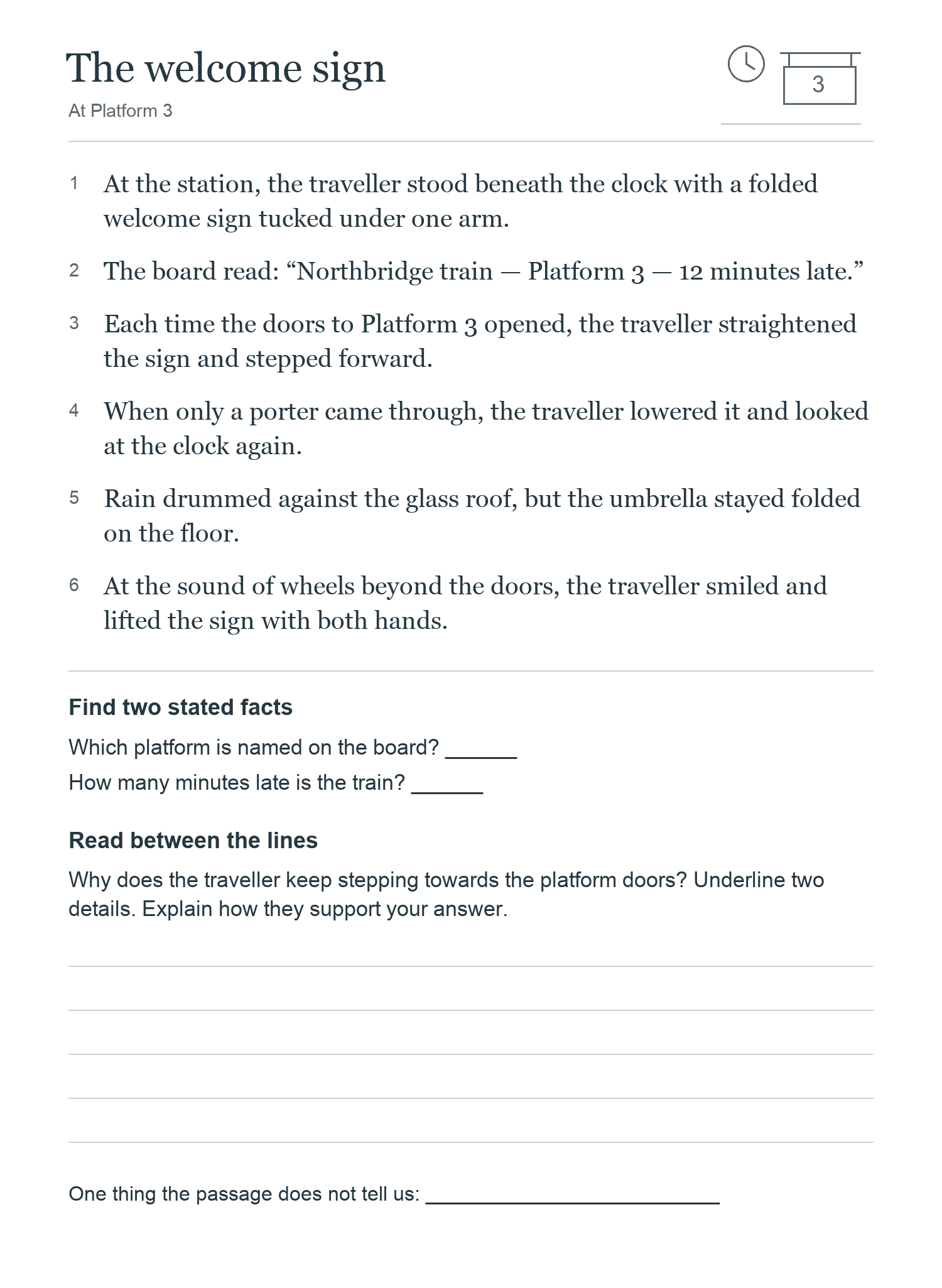
The welcome sign
1. At the station, the traveller stood beneath the clock with a folded welcome sign tucked under one arm.
2. The board read: “Northbridge train — Platform 3 — 12 minutes late.”
3. Each time the doors to Platform 3 opened, the traveller straightened the sign and stepped forward.
4. When only a porter came through, the traveller lowered it and looked at the clock again.
5. Rain drummed against the glass roof, but the umbrella stayed folded on the floor.
6. At the sound of wheels beyond the doors, the traveller smiled and lifted the sign with both hands.
Ask students to read once, then underline two details that might explain the traveller’s actions. Leave the annotations below hidden until you have heard their ideas.

The welcome sign in sentence 1 and stepping forward whenever the doors open in sentence 3 work together: the traveller probably expects to greet someone arriving by train. Sentence 4 adds a useful check. A porter comes through, yet the traveller resumes waiting.
Sentence 5 supplies atmosphere. Rain alone does not explain whom the traveller is waiting for. Ask, “Does this detail support your particular claim?” rather than rewarding every underlined word.
Two locks, then room to write
For a short Deck.Toys route, use a START Signpost, two Slide Activities with Number Locks, then a Slide Activity with the Text App. Copy the passage beside each question so readers can check it as they work. The basic escape room guide explains the activity and path setup.
Use these exact prompts and answers:
- First lock: “Which platform is named on the board? Enter the platform number only.” Configure the answer as 3. Hint: read sentence 2.
- Second lock: “How many minutes late is the Northbridge train? Enter the number only.” Configure the answer as 12. Hint: find the delay on the board, not the platform number.
- Written response: “Why does the traveller keep stepping towards the platform doors? Use two details from the passage and explain how they support your answer.”
Both lock answers are stated in sentence 2. They check precise retrieval; they do not establish that a student can infer the traveller’s purpose. Do not hide an unrelated code inside the passage.
For the final response, enable Long text in the Text App. It accepts free-form writing and lets students move on without an automatic correctness judgement, as explained in Text App versus Lock App. Review the explanation yourself. A pass through this activity is not proof of a sound inference.
Compare these three responses
Compare these responses.
An accurate fact: “The board says the train is 12 minutes late.”
That is literal evidence. The delay is relevant to the continued waiting, but it does not explain the traveller’s purpose in stepping forward. Follow up with: “What might the traveller be hoping to do when the doors open?”
A defensible inference: “They probably expect to meet someone from the train. They have a ‘welcome sign’ and step forward each time the platform doors open, so they seem to be checking whether that person has arrived.”
The writer offers a claim, selects two relevant details and connects them. “Probably” fits the uncertainty: the passage never directly says whom the traveller is meeting.
A guess: “They are meeting their sister after a holiday in France.”
Neither the relationship nor the holiday appears in the passage. Ask the reader to cross out what they cannot support, then rebuild the response from the sign and the actions.
Use this four-point marking check:
- 1 point: a plausible answer to why the traveller steps towards the doors.
- 1 point each, up to 2: two distinct, relevant details from the text, quoted or accurately paraphrased.
- 1 point: an explanation of how those details support the claim.
The worked inference earns 4/4. The literal-only response earns 1/4 for one relevant detail; the unsupported guess earns 0/4. Accept other supported interpretations. “They want to make sure an arriving person can see them” can also earn full credit if the response connects straightening and lifting the welcome sign to that purpose. Mark the reasoning, rather than requiring the model’s wording.
Download the student reading sheet (PNG) or copy the passage, prompts and teacher key (text file). Finish by asking students to name one thing they still cannot know about the traveller. A careful reader should be able to leave a gap open.