Deck.Toys includes built-in AI tools inside the Slide editor to help teachers turn a slide into questions, vocabulary work,...
Scan a Worksheet, Then Check the Maths
 Boon Jin
Updated
You have a worksheet you want to reuse. The questions are already there, but copying them into a digital lesson means handling every fraction, symbol and answer choice again.
The new worksheet scanner gives you a starting point in Lesson Creation Wizard. Here is a small fractions sheet to try, with the details worth checking and a plan for turning it into a short lesson.

Download the clean one-page worksheet (PDF). You can also download it as an image.
Start with the whole page
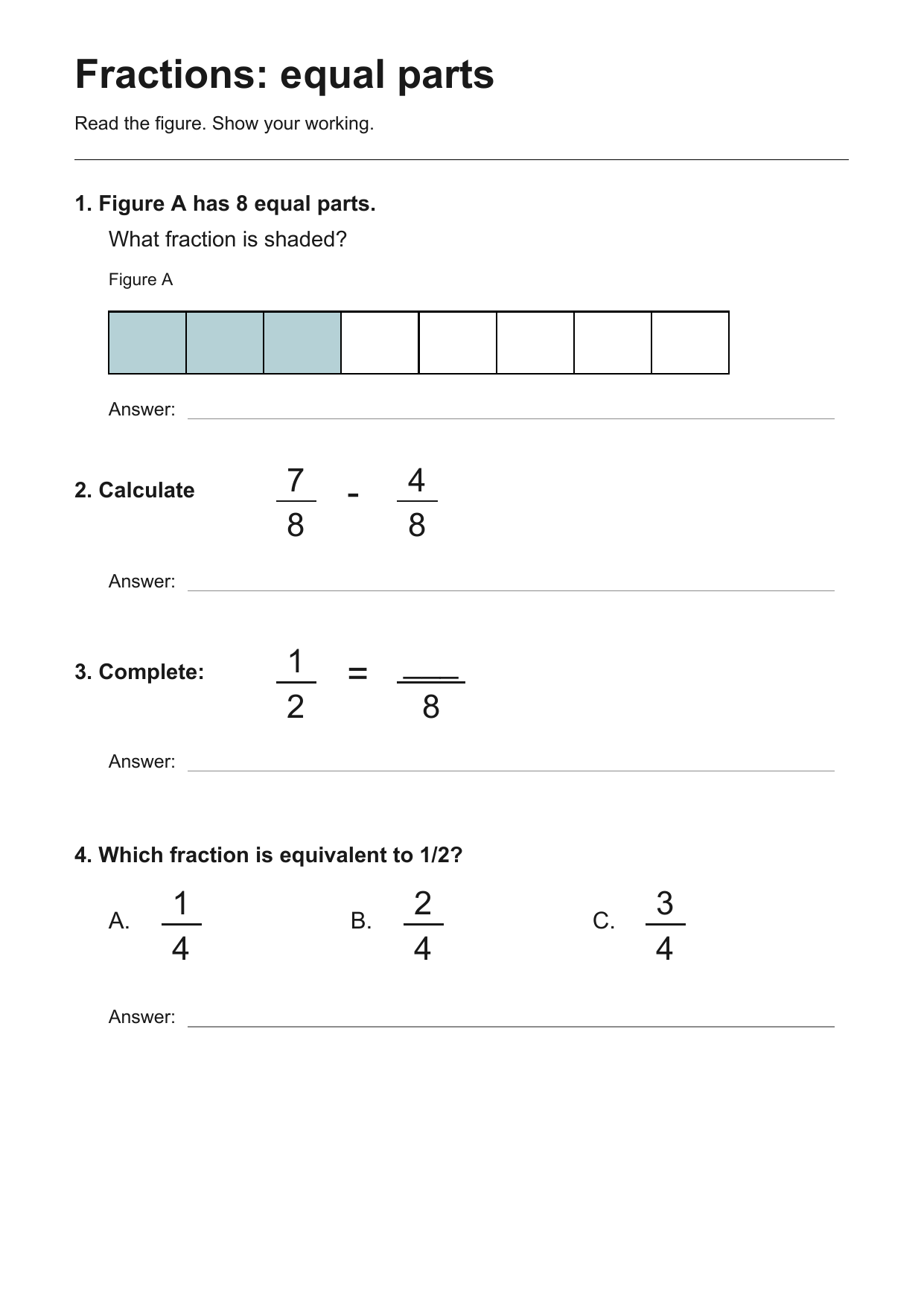
This worksheet has four questions:
- Figure A has 8 equal parts. What fraction is shaded? The figure is a strip divided into eight equal sections, with three shaded.
- Calculate 7/8 − 4/8.
- Complete: 1/2 = ___/8.
- Which fraction is equivalent to 1/2? A. 1/4, B. 2/4, C. 3/4.
Use the clean copy when scanning. It has no names, handwritten answers or school details. With your own materials, choose an unused teacher copy and remove personal information first.
In Lesson Creation Wizard, find Provide Reference Material and choose Scan worksheet. Capture the page, then review the captured pages before continuing. Keep all eight sections of Figure A in the frame, along with the question numbers and all three choices for question 4. A crop that removes blank margins is helpful; a crop that removes the right-hand choices changes the source.

For this sheet, use “Equal parts and equivalent fractions” as the lesson topic. A suitable objective is: “Read a fraction model, subtract fractions with the same denominator, and recognise equivalent fractions.” This gives the lesson a direction beyond simply reproducing a page.
Check the meaning, not just the spelling
Put the source beside the resulting lesson questions. Check for errors like these:
| Source detail | Possible error | What to restore or check |
|---|---|---|
| Q1 refers to Figure A. | The question survives, but the figure is missing. | Keep the complete eight-part strip with the question. Three parts must be shaded. |
| Q2 says 7/8 − 4/8. | The minus becomes a plus. | Restore subtraction. The answer is 3/8, not 11/8. |
| Q3 uses stacked fractions. | 1/2 becomes “12”. | Restore 1/2 = ___/8. The missing numerator is 4. |
| Q4 has choices A, B and C. | Choice C disappears. | Keep 1/4, 2/4 and 3/4. Mark B: 2/4 as correct. |
An answer key needs the same attention. A clearly written question can still have the wrong choice selected as its answer. For a diagram question, also check that the shading and the text agree. Replacing the missing figure with “three of eight equal parts are shaded” preserves the numbers, but changes a visual reading task into a text question.
Give the worksheet a lesson shape
Keep the four questions, but give students something to do with the answers.
Begin with Figure A and question 1. Ask students to explain which number counts the shaded parts and which counts all the equal parts. Then use question 2 for practice: “Seven eighths means seven pieces of this size. Remove four pieces. How many eighths remain?” The denominator stays 8 because the piece size has not changed.
Use question 4 in an MCQ Slide App, with 2/4 selected as the correct answer. MCQ can check that choice automatically. Follow it with question 3 and a spoken or written explanation: “Why does 4/8 represent the same amount as 1/2?” Accept an explanation that four of eight equal parts make half the whole, or that multiplying the numerator and denominator of 1/2 by 4 gives 4/8. A student saying “because 4 is half of 8” should also connect that count to equal parts of one whole.
The Slide Apps guide explains the MCQ option. Use the explanation to hear the reasoning that a correct choice alone cannot show.
Answer key: Q1: 3/8. Q2: 3/8. Q3: 4, giving 4/8. Q4: B, 2/4. Questions 3 and 4 both represent one-half; use them together to connect eighths and quarters.
See the worksheet-scanning announcement for the feature introduction.
