Deck.Toys includes built-in AI tools inside the Slide editor to help teachers turn a slide into questions, vocabulary work,...
Two Routes to Understanding Equivalent Fractions
 Boon Jin
Updated
Adding 1 to the numerator and denominator turns 3/4 into 4/5. Both numbers increase, but the amount changes. This lesson gives students two ways to investigate the rule that works: multiply the numerator and denominator by the same factor to make an equivalent fraction.
Here is a complete lesson to build with four Slide Activities. Everyone answers the first questions, completes one of two routes, then returns to the same exit task. It assumes students can already identify a numerator and denominator.

1. Show what you know
Add a Text App with Long text for these three prompts. It collects a free response without requiring an exact correct answer to continue. Use students’ explanations to recommend a route; the questions do not automatically assign one.
- Are 1/2 and 2/4 equal? Explain how you know.
- Complete 2/3 = □/12. Explain what happened to both numbers.
- A claim says, “3/4 = 4/5 because I added 1 to both numbers.” Is the claim correct? Explain.
Teacher key: 1/2 = 2/4 because splitting each half into two equal pieces gives four quarters, with two shaded. The missing numerator is 8: multiply both 2 and 3 by 4. The final claim is false: multiplying both numbers by the same factor preserves the amount; adding 1 does not. With equal-sized wholes, 3/4 = 15/20 while 4/5 = 16/20.
For the route choice, write: “Choose Build with strips to see why the amount stays the same. Choose Measure a recipe to use equivalent fractions with measuring cups.” Recommend the strip route when an answer uses an addition rule or cannot explain the equality. Recommend the recipe route when the student can justify the same multiplier. A student can still choose a model to check an idea. Labels such as “easy,” “hard,” “catch-up” or “expert” tell students little about the actual work.
2A. Build with strips
Use equal-length rectangles throughout. The fraction-strip sheet supplies the models below; save it to use in your slides.
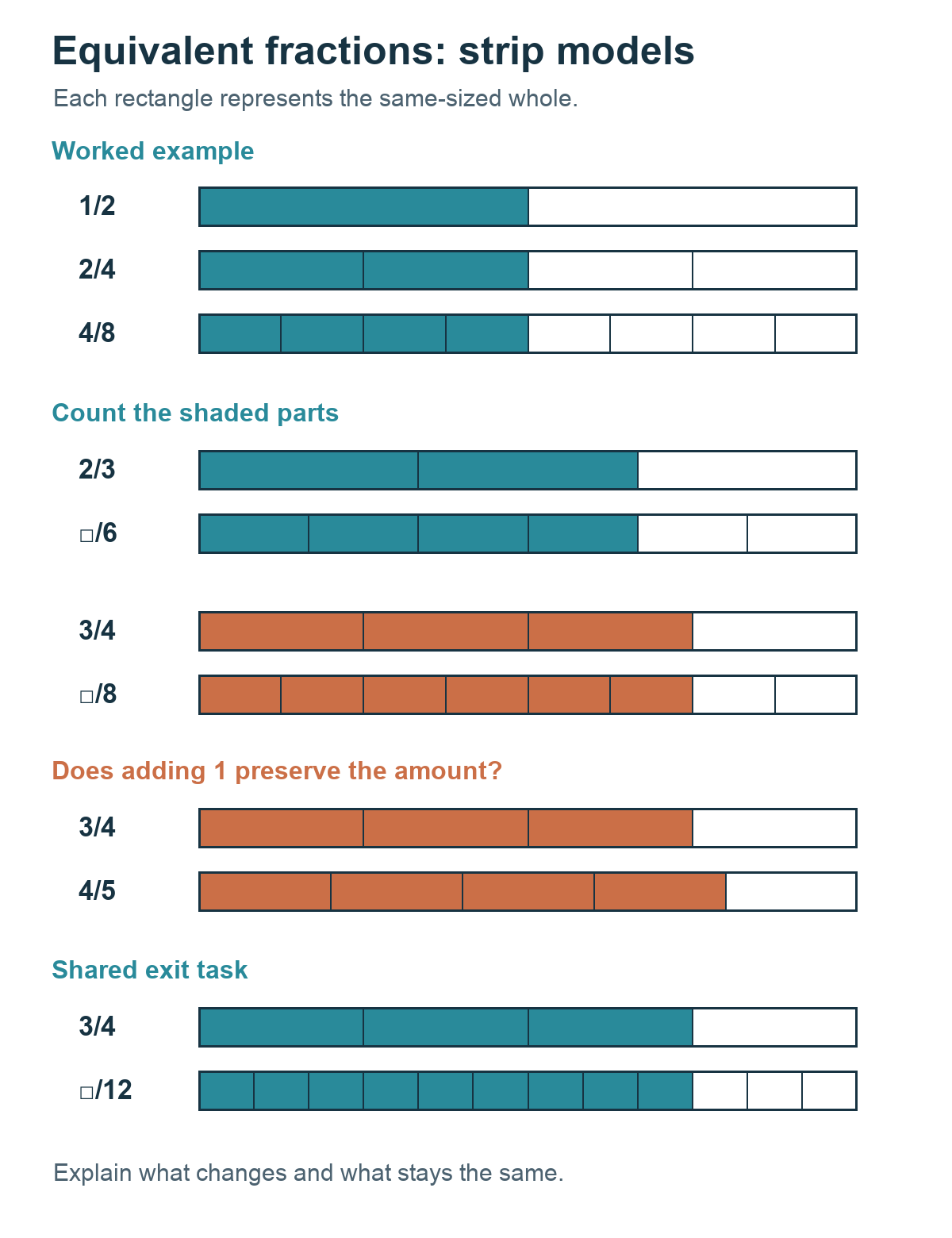
Worked slide: Show 1/2, 2/4 and 4/8 shaded on three matching strips. Add: “We cut each piece into smaller equal pieces. There are more pieces altogether and more shaded pieces, but the shaded length stays the same. Multiply the numerator and denominator by 2: 1/2 = 2/4. Do it again: 2/4 = 4/8.”
Practice slide: Show the thirds/sixths and quarters/eighths models. Put these prompts in a Text App:
- “Complete 2/3 = □/6. Explain using the shaded pieces.”
- “Complete 3/4 = □/8. State the multiplier.”
- “Would 3/4 = 4/5 fit these models? Explain what an extra shaded piece and an extra total piece would change.”
Teacher key: 4/6, because each third becomes two sixths; 6/8, using ×2 on both numbers. The final equality is false: 4/5 shades more of the whole than 3/4. “Both numbers increased” is not sufficient evidence of equivalence.
2B. Measure a recipe
State that every measuring cup refers to the same one-cup unit. Put the worked example on the first slide:
“A recipe needs 2/3 cup of yogurt. A scoop holds 1/6 cup. Each third contains two sixths, so 2/3 = 4/6. Four scoops measure the required amount.”
On the next slide, add these Text App prompts:
- “The next recipe needs 3/4 cup. You have a 1/8-cup scoop. How many full scoops do you need? Show the equivalent fractions.”
- “Could you replace 3/4 cup with 4/5 cup because both numbers increased by 1? Explain.”
- “A one-cup bowl and a two-cup bowl are each 3/4 full. Do they contain the same amount? Explain.”
Teacher key: Six scoops: 3/4 = 6/8. The replacement would use too much: 3/4 = 15/20, whereas 4/5 = 16/20. The bowls contain different amounts: 3/4 cup and 1½ cups. A matching fraction describes the same proportion, but the wholes must match to compare amounts.
3. Explain the equivalence
Give everyone this Text App exit task:
Complete 3/4 = □/12. Explain why the two fractions represent the same amount. You may use equal-sized strips or measuring cups. Then explain why adding 1 to both numbers would not give an equivalent fraction.
Expected response: “3/4 = 9/12. Each quarter becomes three twelfths, so the three shaded quarters become nine shaded twelfths. Both numbers were multiplied by 3 and the whole stayed the same. Adding 1 gives 4/5, which is a larger fraction.”
Look for three things: the correct numerator, an explanation of the same factor, and attention to the whole. A response of “9, because 4 × 3 = 12” gets the calculation right but leaves the numerator’s change unexplained. Use that difference to choose the next teaching example.
Make the join match the lesson
Turn on paths and make Show what you know the only entry point. Connect it to both branch activities. Connect each branch directly to Explain the equivalence, with no shortcut from the start to the exit.
On the exit activity, configure the Activity Entry Lock → Activities to require at least 1 completed neighboring activity. That lets a student arrive from either completed route. The Activity Entry Lock guide defines a neighbor as an activity connected by a path; the count concerns those neighbors, not every activity anywhere on the deck. This gate checks completion. Use the exit responses to assess the mathematics.
Require at least 2 only if you change the instruction to “Complete both routes.” With exactly these two branch neighbors, that setting makes both mandatory. The Lock Guide explains this difference. Test the join by completing only the strip route, then only the recipe route in a fresh run: each should open the exit. Completing the shared start alone should not.
